
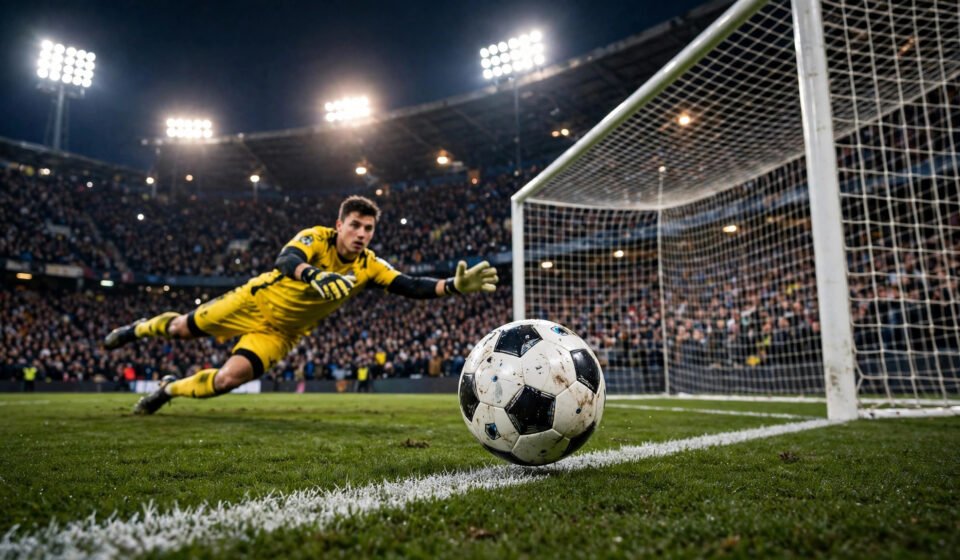

Every football fan old enough to remember it can picture the moment. A shot crashes against the underside of the crossbar, bounces down, and spins back out. Half the stadium screams that it crossed the line. The other half screams that it did not.
The referee waves play on, and the argument lasts for years. For most of football’s history, the most important question in the game was answered by guesswork. Then goal-line technology football arrived, and the argument ended in under a second.
Table of Contents
The Goal That Changed Everything
Two moments forced the change. The first was the 1966 World Cup final, when Geoff Hurst’s shot hit the bar and bounced down on the line. The referee gave the goal, England went on to win, and people have argued about it ever since.
The second was the 2010 World Cup, when Frank Lampard’s shot for England against Germany clearly crossed the line by nearly a metre, and the goal was not given. That one was different. It happened on live television, in front of hundreds of millions of viewers, and everyone watching at home could see the truth while the officials on the pitch could not.
Within two years, football’s lawmakers approved goal-line technology, and the Premier League brought it in for the 2013–14 season. The game had resisted cameras for a century. One obvious mistake ended the resistance.
Goal-Line Technology Football: The Cameras Behind the Decision
So how does it actually work? This is goal-line technology football explained in simple terms. The most widely used system, Hawk-Eye, places a ring of high-speed cameras around each goal, usually seven per goal, mounted high in the stadium roof.
Each camera films at hundreds of frames per second and tracks the ball in three dimensions. A computer compares the images from several cameras at once and works out the exact position of the ball many times every second. It knows where the goal line is, to within a few millimetres, because the system is calibrated before every match.
The moment the whole of the ball crosses the whole of the line, the system sends a signal. That is the rule, and it matters: the whole ball must be over the whole line. A ball that is ninety-nine per cent over is not a goal, and the cameras can tell the difference.
Hawk-Eye and the Watch That Buzzes
The signal goes to a special watch worn by the referee. Within about one second of the ball crossing the line, the watch vibrates and displays the word GOAL. There is no screen for the referee to study and no long wait. The referee simply gets a quiet buzz on the wrist and awards the goal.
If the ball does not cross the line, nothing happens, and play continues as normal. The speed matters as much as the accuracy. Football refused technology for years partly because officials feared it would slow the game down. A one-second buzz solved that objection completely.
The crowd barely has time to react before the decision is already made, and that is the point. Hawk-Eye football works because it is invisible. When it works well, nobody notices it at all. The only time people talk about it is when it is not there, in a lower league or a cup match at a small ground, and a disputed goal reminds everyone what life was like before.
What Changed for Players, Referees and Fans
The effects went further than one decision per match. Goalkeepers stopped getting away with scooping the ball out from behind the line, and attackers stopped being robbed of goals that television viewers could see plainly. Referees gained something valuable too: protection.
Before the technology, a referee who missed a goal-line call could be blamed for deciding a title or a relegation. Now the call is made by cameras, and the referee is free to concentrate on everything else. Fans changed as well. The old arguments about whether the ball crossed the line have mostly disappeared from pubs and phone-ins, replaced by arguments about VAR, which is a different system entirely and a much slower one.
In a way, that proves the point. People argue about VAR because it involves judgement. Nobody argues about goal-line technology football, because there is nothing to argue about. The ball either crossed the line or it did not, and the cameras know.
Technology has changed sport in other areas too, and our guide to how sports analytics changed the way coaches pick a starting lineup shows how data is reshaping decisions all over the game.
The Arguments That Remain
No system is perfect, and goal-line technology football has its critics. The first complaint is cost. Installing and running the camera system is expensive, which is why it exists in top divisions and major tournaments but not in most lower leagues.
A goal that would be given in the Premier League can still be missed in the third tier, and that gap bothers many fans. The second complaint is about the occasions when the system itself has failed, which are rare but real. There have been a handful of matches where the cameras were blocked or the watch did not buzz, and each one makes the news precisely because it almost never happens.
The third argument is philosophical. Some fans feel that removing all doubt removes some of the drama, that football was more fun when a wrong decision could be argued about for decades. It is a fair point, but it is a hard one to defend to the team that loses a cup final to a goal that never was. The balance of opinion has settled firmly in favour of the cameras.
Why the Line Will Never Be Argued About Again
Goal-line technology football succeeded where other football technology still struggles, because it answered a question with a simple yes or no. There was no interpretation, no judgement call, and no delay. That is why it was accepted so quickly by players, managers, and fans who had resisted every earlier attempt.
The lesson reaches beyond football. The same kind of precision tracking is now changing how athletes train and recover, as our look at how recovery science is changing athletes in 2026 explains.
The technology keeps improving, the cameras keep getting faster, and the margin of error keeps shrinking. But the real change already happened. A question that once decided World Cups on a guess is now answered in a second, and the game is better for it. The arguments have moved on to other decisions, and the goal line itself is finally quiet. The official Laws of the Game explain the system in full for anyone who wants the technical detail.