

Fridge organization life hacks sound boring until you open your fridge and find the yoghurt you bought last week hiding behind a jar you forgot you owned. Most food waste does not happen because people buy too much. It happens because food gets lost, forgotten, or stored in the wrong place, and by the time anyone notices it, it is too late to eat it.
A tidy fridge is not about being perfect. It is about being able to see what you have, reach it quickly, and use it before it goes bad. These seven fridge organization life hacks do exactly that, and none of them needs expensive equipment or a whole afternoon.
1. Zone Your Fridge Like a Shop
Every fridge has warm spots and cold spots, and food lasts longer when it lives in the right one. The door is the warmest part, because it opens and closes all day, so it is the worst place for milk and eggs, even though most fridges put egg holders there. Keep condiments, sauces and drinks in the door instead.
The top shelf is the steadiest temperature, so it suits leftovers, cooked food and things you eat every day. The middle shelves are for dairy and ready-to-eat food. The bottom shelf is the coldest, so raw meat and fish go there, in a tray, where they cannot drip onto anything else. The drawers at the bottom are for fruit and vegetables, because they hold humidity better than an open shelf.
Once you know the zones, stop moving things around. When everything has a home, you stop opening the fridge and staring at it, and you stop buying a second bottle of something you already have.
2. Use Clear Bins So You Can See Everything
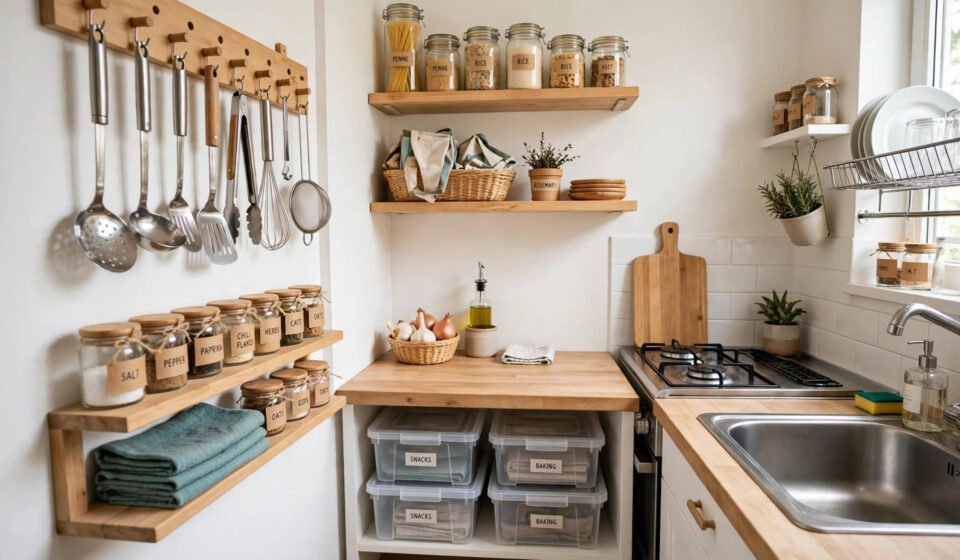
The single best fridge organization life hack is also the simplest: put things in clear bins. A bin for breakfast things, a bin for sauces, a bin for snacks. When you want something, you pull out the whole bin instead of moving ten jars to reach the one at the back.
Clear bins work because they stop food from disappearing. A small pot of leftovers at the back of a shelf is invisible. The same pot in a clear bin at the front is obvious. That is also why our guide to small kitchens works on the same idea: when space is tight, seeing what you have matters more than having more space.
You do not need matching designer bins. Any clean, food-safe container works, and one bin per group is enough. Label the bin if more than one person uses the fridge, so everyone puts things back in the same place.
3. First In, First Out — Every Time
Shops use a simple rule, and it works at home too: first in, first out. When you buy a new carton of milk, put it behind the one that is already open. When you cook a new batch of food, put it behind yesterday’s leftovers. The oldest food gets used first, and nothing sits at the back until it goes bad.
This one habit saves more money than any gadget. Most households throw away food that was perfectly good a few days ago, simply because a newer packet was in front of it. Moving the new packet to the back takes five seconds, and it is the difference between eating the food and binning it.
4. Label and Date Your Leftovers
Leftovers are the food most likely to be wasted, because nobody remembers when they were cooked. A small piece of masking tape and a pen fixes that. Write what it is and the date you cooked it, and stick it on the container.
If it is more than three or four days old, throw it away. That is not being wasteful — it is being safe. The label also stops the daily argument about whether something is still good. If there is no date on it, nobody trusts it, and it stays in the fridge until someone finally throws it out.
The same idea works for the freezer. A frozen meal with no label is a mystery nobody wants to defrost. A frozen meal with a name and a date is dinner.
5. Keep an “Eat First” Box
Even a well-organised fridge has food that needs using soon: the last tomato, half an onion, the yoghurt that expires tomorrow. Put all of it in one clear box at eye level, and call it the “eat first” box.
When you are deciding what to cook, look in that box first. It turns leftovers and odd bits into the starting point for a meal, instead of letting them sit until they are past saving. It is also the fastest way to cut waste, because the food that needs eating is the food you actually see.
This is the same thinking behind saving money on everyday shopping: the saving does not come from one big change, it comes from small habits that stop you buying the same thing twice.
6. Stop Overfilling the Fridge
A fridge that is packed full does not stay cold evenly. Cold air needs space to move, and when every shelf is crammed, the food at the back gets too cold and the food at the front gets too warm. That is how milk goes off early and lettuce goes limp.
Leave a little space between items, and do not block the vents at the back. If your fridge is always full, that is a sign to shop a little more often and buy a little less each time, rather than doing one huge shop and stuffing everything in. Fresh food that you can see and reach is worth more than a fridge that looks full.
7. Do a Two-Minute Reset Every Week
Fridge organization life hacks only work if the system survives the week, and the way to make it survive is a two-minute reset. Pick one day — the day before your usual shop is ideal — and spend two minutes on it. Throw away anything out of date, move the “eat first” food to the front, and wipe up any spills.
Two minutes is short enough that you will actually do it, and it stops the slow slide back into chaos. A fridge that gets a weekly reset never needs a big, horrible clean-out, because nothing is ever left long enough to become a science experiment.
The future home will probably do some of this automatically, with fridges that track expiry dates and suggest recipes, as described in our look at what homes will look like in 2035. Until then, a clear bin and a piece of tape do the same job for almost no money.
The Bottom Line
Fridge organization life hacks work because they fix the real problem: food you cannot see is food you will not eat. Zone the fridge, use clear bins, put new food behind old food, label your leftovers, keep an “eat first” box, do not overfill it, and reset it for two minutes a week. None of these steps is hard, and together they save food, save money, and make cooking faster. For safe storage times for common foods, check the cold food storage charts on FoodSafety.gov.