
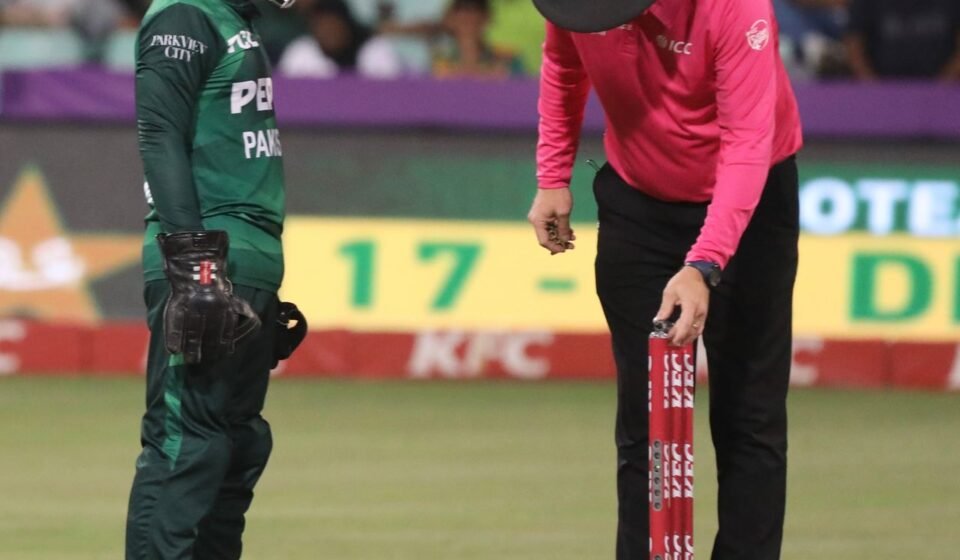

How DRS works in cricket is a question almost every cricket fan has asked at least once, usually while staring at a replay on the big screen and waiting for a red or green light. DRS stands for the Decision Review System, and it is the process that lets players challenge an umpire’s decision and lets technology check it. It has changed cricket more than any other single rule in the last twenty years, and it has done it by answering questions that used to be settled by argument.
The idea is simple. The on-field umpire makes a call. A team that disagrees can ask for a review. The third umpire, sitting with the replays and the tracking data, checks the decision and either confirms it or overturns it. The whole thing usually takes less than a minute, and the stadium watches it happen live. That is the heart of how DRS works in cricket, and why the system is trusted even when it overturns a decision.
Table of Contents
What Is DRS?
DRS is a review system, not a replacement for the umpire. That distinction matters, because it shapes everything else about how it works. The umpire on the field still makes the first decision, on every ball, in real time. DRS only comes in when a team asks for it, and each team gets a limited number of reviews per innings. If a review is successful and the decision is overturned, the team keeps it. If the review fails, the team loses one.
That limit matters, because it stops teams from reviewing every close call, and it keeps the game moving. A team that wastes its reviews early has none left for the moment that matters, which is why captains think hard before asking. The system is a safety net for clear mistakes, not a second umpire for every ball.
DRS is used for the big decisions: LBW appeals, caught behind, caught at slip, and run outs. It is not used for everything. A wide, a no-ball for height, or a judgement about a player’s intent still belongs to the on-field umpire alone, and no review can change those calls. That limit is a key part of how DRS works in cricket in practice, not just in theory.
The Three Technologies Behind DRS
How DRS works in cricket depends on three different technologies, each answering a different question.
The first is ball tracking, usually Hawk-Eye. High-speed cameras around the ground track the ball from the bowler’s hand, work out where it pitched, where it hit the pad, and then predict where it would have gone if the pad had not been in the way. That prediction is shown as a graphic, with the ball’s path continuing to the stumps. Our article on how Hawk-Eye works in tennis and cricket (https://thinkforges.com/how-hawk-eye-works-in-tennis-and-cricket-in-2026/) explains the camera system in detail — the same tracking that decides line calls in tennis decides LBW calls in cricket.
The second is UltraEdge, also called Snicko. It uses a sensitive microphone on the stumps to detect the tiny sound of the ball touching the bat. On the replay, the sound is shown as a spike on a graph, timed against the video, so the third umpire can see whether the bat touched the ball at the exact moment it passed. It is the main tool for caught-behind decisions, where the question is whether the ball brushed the edge.
The third is Hot Spot, an infrared camera that shows where the ball made contact, as a bright mark on the bat or pad. It is used less often now than UltraEdge, because it needs the right conditions and can miss a faint edge, but it is still part of the toolkit in major series.
No single technology decides a review. The third umpire looks at all of them together — the tracking, the sound, the heat mark, and the ordinary replay — and makes one decision. Together, these three tools explain how DRS works in cricket on almost every review.
How a Review Works, Step by Step
A review follows the same steps every time. First, the captain asks for it, usually within fifteen seconds of the decision, by making a “T” shape with their hands. The on-field umpire then asks the third umpire to check it, and the big screen shows the process.
For an LBW, the third umpire checks three things in order: where the ball pitched, whether it hit the pad in line with the stumps, and whether the tracking predicts it would have hit the stumps. For a caught behind, the check starts with UltraEdge: was there a sound as the ball passed the bat? For a catch, the replay is slowed down frame by frame to see whether the ball touched the ground before the fielder caught it.
Each check is shown to the crowd, which is part of why the system works. Everyone in the stadium sees the same evidence at the same time, and the decision, when it comes, is hard to argue with. The third umpire then tells the on-field umpire the outcome, and the umpire signals it: out, or not out. Each of those checks shows how DRS works in cricket, step by step, in front of the crowd.
Umpire’s Call Explained
The most argued-about part of DRS is the umpire’s call, and it is also the most misunderstood. When the ball tracking predicts the ball would have hit the stumps, but only just — clipping the edge of the stumps by a few millimetres — the original decision stands. If the umpire gave it out, it stays out. If the umpire gave it not out, it stays not out.
That frustrates fans, because the graphic can show the ball hitting the stumps and the decision still does not change. But the rule exists for a good reason: the prediction has a margin of error, and cricket decided, fairly, that a marginal prediction should not overrule a human who was there. The technology is accurate, but it is not perfect, and the umpire’s call is the system’s way of admitting that.
The same idea now decides goals in football too, as our article on how goal-line technology ended football’s biggest arguments (https://thinkforges.com/how-goal-line-technology-ended-footballs-biggest-arguments/) explains. The sports are different, but the principle is the same: technology that removes doubt, and a human decision that stands when the doubt is too small to measure. That margin for error is built into how DRS works in cricket, and it is why umpire’s call exists.
What Changed for Players and Fans
The effects went further than one decision per match. Batsmen stopped walking off in disbelief at a bad LBW, because they knew a review could fix it. Bowlers stopped appealing for everything, because a failed review costs the team. Umpires gained protection too: a wrong call could be corrected in seconds, instead of deciding a match and following the official for years.
For fans, the review became part of the drama. The fifteen seconds while the captain decides, the replay on the big screen, the slow build of the ball-tracking graphic, and the final signal — it is now one of the most tense moments in a match, and the crowd watches it together.
Technology has changed cricket in other areas too, and the pattern is the same everywhere: cameras that never blink, data that never guesses, and a human who still makes the final call. DRS is the most visible example, because every fan can see it working, live, on the screen. For players and fans alike, that drama is now part of how DRS works in cricket in the modern game.
Where DRS Still Cannot Help
No system is perfect, and DRS has its limits. The first is cost. Installing and running the camera and tracking systems is expensive, and it is mostly the richer boards that can afford the full setup. That means a series between two smaller teams may not have the same technology as a World Cup final.
The second is that the system can only answer the questions it was built to answer. It can track a ball and listen for an edge, but it cannot judge a no-ball for overstepping, a wide, or a player’s intent. The third is the prediction problem. A system that predicts where a ball would have gone is only as good as its model, and on some pitches that model is less reliable than on others. Fans and players need to remember that the prediction is a best guess, not a fact.
The Bottom Line
How DRS works in cricket is, in the end, a simple idea done well: the umpire decides, the team can ask, and the technology checks, in seconds, in front of everyone. It made the hardest decision in the game — the LBW — fairer, and it made caught-behind and close catches fairer too, even if it could not make them perfect. The arguments have moved on to the umpire’s call and the marginal predictions, and the howler — the decision everyone could see was wrong — has mostly disappeared. That is the real lesson of DRS: technology works best in sport when it removes doubt without removing the human from the game. For a plain overview of the system, see the Decision Review System entry on Wikipedia (https://en.wikipedia.org/wiki/Decision_Review_System).