
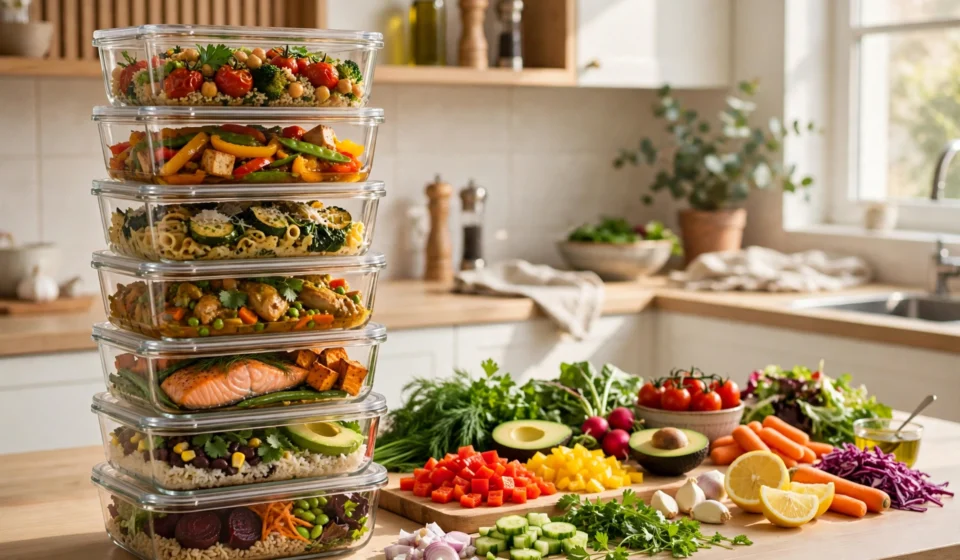

It is 6pm, you are hungry, the fridge has half an onion and a jar of pickles, and dinner is somehow your problem again. You order takeaway and promise yourself you will cook tomorrow. This is the loop that meal prep for beginners is meant to break, and it works, but only if you start small. Most beginners fail because they copy the version they see online: twenty containers, five recipes, a whole Sunday gone. The real system is much simpler. One afternoon, a few big batches, and seven dinners that are ready before you are hungry.
The idea is not to cook seven different meals. Nobody has time for that, and nobody needs it. The idea is to cook three or four big things, mix them into different combinations, and let the week take care of itself. A tray of roast chicken becomes three different dinners, and a pot of rice covers the rest. The work happens once, and the payoff is a week of evenings where dinner is a decision you already made.
Why Most Beginners Quit Meal Prep in Week One
The first mistake is ambition. Beginners plan seven different recipes, buy ingredients for all of them, and spend four hours in the kitchen on day one. By Tuesday they are sick of cooking, and the whole experiment feels like a punishment. Meal prep for beginners is supposed to save time, not move all of it to Sunday. If your first week feels like a second job, the system is wrong, not you.
The second mistake is cooking food you do not actually like. A meal you would never order and would never cook on a normal evening will not become appealing just because it is sitting in a container. The best easy meal prep ideas are the meals you already enjoy: the chicken you make anyway, the pasta you always order. Start with those, and the containers will empty themselves.
The third mistake is no plan for the food after day three. Cooked chicken and rice keep well in the fridge for three to four days, and then they do not. Beginners who cook everything on Sunday and leave it all in the fridge are eating tired food by Thursday, or throwing it away. The fix is simple: freeze half of what you make, and move it to the fridge the night before you need it.
Meal Prep for Beginners: The One-Afternoon System
Here is the system, stripped to its essentials. Pick three proteins you like: chicken, mince, lentils, eggs, beans, whatever your household actually eats. Pick two bases: rice and pasta, or rice and flatbread. Pick three vegetables that roast well: carrots, peppers, courgettes, sweet potato. That is your whole shopping list, and it is deliberately boring.
Cook them in big batches, all at once. The chicken goes in the oven, the rice goes on the hob, the vegetables roast on the same tray, and the lentils simmer in a pot. The whole job takes about two hours, including the washing up. That is the secret of weekly meal prep dinners: the work is in the ingredients, not in the recipes, and four ingredients can become a dozen different dinners. That is what meal prep for beginners is really about.
A 7-Day Dinner Plan From One Afternoon
Monday is roast chicken with rice and roasted vegetables, the simplest plate of the week, and the one that reminds you the system works. Tuesday is the same chicken, shredded into flatbread with salad and sauce, which feels like a completely different meal even though nothing new was cooked. Wednesday is lentil curry with rice, which tastes better on the third day.
Thursday is pasta with the leftover roast vegetables and a tin of tomatoes, which takes ten minutes and uses up the vegetables before they go soft. Friday is mince, cooked with onions and spices, served with flatbread and salad. Saturday is the freezer meal: the chicken and rice you froze on Sunday, reheated and served with fresh salad. Sunday is eggs, beans, or whatever is left, plus the one fresh meal you cook that day.
The point of meal prep for beginners is not that you must follow a plan exactly. The point is that seven dinners came from one afternoon, and none of them required a new recipe, a new shop, or a new decision at 6pm. Swap the proteins and change the days around, and the system still holds.
Storage Rules That Keep Food Safe and Tasty
Good meal prep containers matter more than most beginners expect. Glass containers with tight lids keep food fresh longer than cheap plastic, they reheat without staining, and you can see what is inside without opening them. Buy eight to ten, all the same size, so they stack neatly and you are never hunting for a matching lid. Label each one with the date, because a container of mystery food gets thrown away. A cheap roll of masking tape and a marker are all you need for labels that survive the fridge.
The food-safety rules are simple and worth following exactly. Cool cooked food within two hours before it goes in the fridge. Eat fridge meals within three to four days. Freeze anything you will not eat by then, and defrost it in the fridge overnight, never on the counter. Reheat food until it is steaming hot all the way through, and only reheat it once. These rules are the reason your Thursday dinner tastes as good as your Monday one.
Mistakes to Avoid in Your First Month
Do not prep breakfasts and lunches in the same week you start dinners. One change at a time is how habits stick, and for meal prep for beginners, dinners alone will save you more time and money than any other meal. Do not buy new equipment before your first week: your existing pots, one baking tray, and a set of containers are enough. Do not cook food nobody in the house likes, and do not prep more than your fridge can hold, because food you cannot store is food you will throw away.
And do not aim for perfect. Some weeks the plan will fall apart and you will order takeaway on Wednesday. That is not failure. That is a normal week, and the system is still there on Sunday, ready to start again. The people who stick with meal prep treat a missed week as a missed week, not a reason to quit.
The Bottom Line
Meal prep for beginners is not about cooking like a chef or living like a fitness influencer. It is about solving the 6pm problem once, on a quiet afternoon, instead of solving it badly every single evening. Cook a few big batches, mix them into different dinners, freeze half, and let the week run itself. The first week will feel clumsy, the second easier, and by the third you will wonder why dinner used to be a daily crisis.
Our kitchen life hacks will save you time on the busiest weekdays. And if your kitchen is short on space, our other guide helps too.