
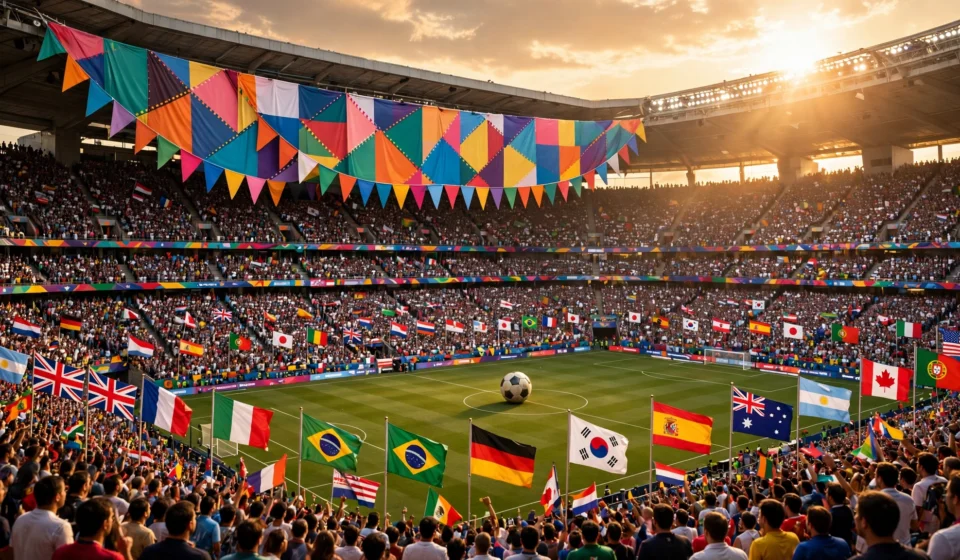

When Spain beat Argentina 1-0 after extra time in the 2026 World Cup final, the match itself was a classic: tight, tense, decided by a single goal in front of 82,500 people at MetLife Stadium in New Jersey. But the final was only the last chapter of a tournament that had already changed football. The 48-team World Cup was the biggest in history, with 104 matches played over 39 days in 16 cities across three countries. It was longer, louder, and more open than any World Cup before it. This is how the new format worked, what it changed, and why football will not go back.
The first thing to understand is how much bigger this World Cup was. The old format, used since 1998, had 32 teams and 64 matches. The 2026 edition nearly doubled the field and added 40 more games. The tournament ran from June 11 to July 19, with matches almost every day. Fans suddenly had a tournament that never seemed to stop, with four matches on some days.
The World Cup 2026 Format: 12 Groups and a New Knockout Round
The World Cup 2026 format was built around 12 groups of four teams. The top two in each group advanced, along with the eight best third-placed teams, making a round of 32 that had never existed before. From there it was familiar: round of 16, quarter-finals, semi-finals, and the final. The new round added a whole extra stage of knockout football, which meant more do-or-die matches, more giant-killings, and more chances for a smaller team to make a run.
The third-place rule changed how teams played. In the old format, finishing third meant going home. In 2026, third place could still be enough, which meant teams kept attacking even when they were losing, because a single goal could be the difference between advancing and going home. Group games that would once have been dead rubbers became live contests.
The format also changed the maths of winning the tournament. A champion now had to play eight matches instead of seven, which meant an extra week of football, an extra round of injuries and suspensions, and a deeper squad. Spain, the eventual winners, used their whole squad across the tournament. That will shape how national teams build their squads for years to come.
16 Host Cities Across Three Countries
The 48-team World Cup was also the first to be hosted by three countries at once: the United States, Canada, and Mexico. There were 16 World Cup host cities in total, and the tournament stretched across a continent. The opening match was in Mexico City, at the Estadio Azteca, and the final was in New Jersey, nearly 4,000 kilometres away. No single city owned the tournament.
That scale brought problems as well as spectacle. Teams travelled thousands of kilometres between matches, crossing time zones and climates, and fans who wanted to follow their team had to cross borders and book flights between cities. Some supporters loved the road-trip feel, with a different city every few days. Others found it exhausting and expensive, and many fans watched from home instead. The three-country model may not be repeated, but the bigger, more spread-out World Cup is here to stay.
More Teams, More Stories
The biggest argument for the 48-team World Cup was always the same: more teams means more stories. Sixteen extra places meant more debutants, more smaller nations, and more fans seeing their country at a World Cup for the first time. Several of them won games, took points off famous opponents, and gave the tournament its most memorable moments. The group stage was full of results that could never have happened in a 32-team field.
That is the heart of the change. A World Cup with 48 teams is not just a bigger version of the old one. It is a different tournament, where the early rounds are less predictable, where a famous team can be knocked out by a side nobody had heard of, and where the road to the final is longer and harder. Some group games were one-sided. But the tournament as a whole was more surprising and more dramatic than any before it.
The Cost of the 48-Team World Cup: Fixture Congestion
None of this came free. The 104 matches World Cup schedule meant more football in a shorter window, and the players paid for it. Stars arrived tired from long club seasons, played up to eight matches in five weeks, and went straight back to their clubs. Injuries were a constant story, and several of the biggest names missed games. Managers complained, clubs complained, and the players’ union raised the same point it has raised for years: the calendar is too full, and the people who pay for it are the players.
The travel added to the load. Teams that played in Mexico one week and Canada the next were dealing with altitude, heat, and time-zone changes on top of the matches themselves. The finalists, Spain and Argentina, both had to manage their squads carefully, rotating players and accepting that some games would be won ugly. The extra round made squad depth matter more than ever. That is the strongest argument the critics have.
The Money, the Audience, and What Comes Next
The commercial case for the 48-team World Cup was never in doubt. More matches meant more tickets, more television, and more money. The final alone drew a global audience in the billions, and the tournament set records for attendance and viewing figures. The closing ceremony and the first World Cup half-time show, staged before the final, showed how far the event has moved towards a global entertainment spectacle.
That money matters, because it decides what happens next. The 48-team format is now the standard, and future World Cups will be built on the same model. The next edition, in 2030, will be spread across even more countries, and the lessons of 2026, about travel, scheduling, and squad depth, will shape how it is planned. The tournament will not go back to 32 teams. The only question is how the format is refined.
The Bottom Line
The 48-team World Cup changed football because it changed what a World Cup is. It turned a month-long tournament into a 39-day event across a continent, gave sixteen more nations a place at the table, and added a whole new knockout round. It was bigger, messier, and more surprising than the tournament it replaced. The format is not perfect, and the cost to players is real. But the 2026 World Cup proved that a bigger tournament can still produce a great one, and football will be living with that proof for a long time. The next World Cup will be judged against this one, and that is the real measure of how much changed. The game is bigger now, for good. For more on how the game itself keeps changing, our guide to goal-line technology explains the innovation that ended football’s biggest arguments. And for the system that still divides fans more than any other, here is how VAR is changing the decisions on the pitch.