
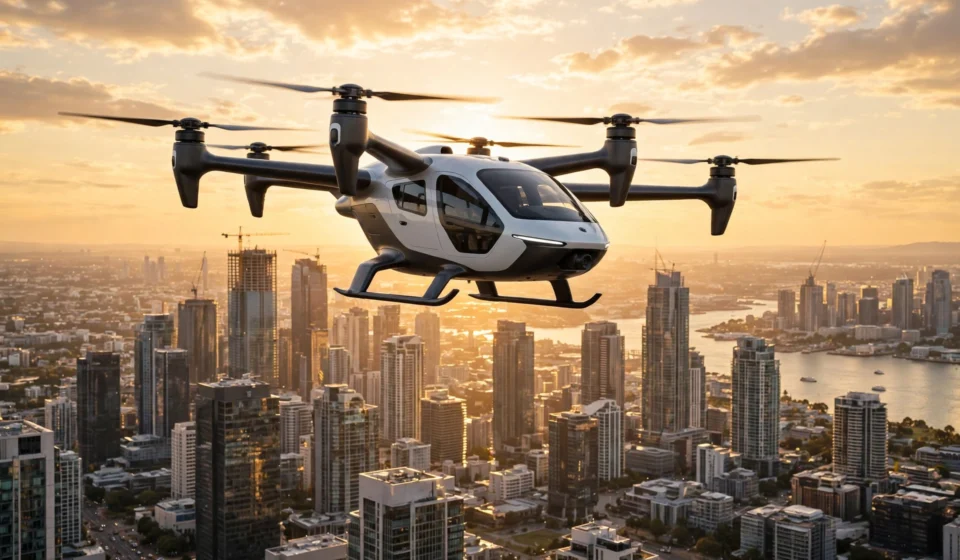

For more than a century, science fiction has promised us flying cars. The future kept arriving, and the flying car never did. Now, quietly and without much of the old hype, something close to it is actually flying: electric aircraft carrying a handful of passengers across a city, being tested in the United States, Europe, China, and the Middle East. So the question is no longer whether flying taxis will exist, but when you will be able to hail one.
Here is where flying taxis 2026 stand, and what still has to be solved.
What Is a Flying Taxi, Exactly?
A flying taxi is not a car with wings. It is a small electric aircraft, carrying two to six passengers plus a pilot, for short trips across a city. Most are eVTOL aircraft, electric vertical take-off and landing: they take off straight up like a helicopter, then switch to winged flight like a plane, making them far more efficient than a helicopter over the same distance. They are much quieter than helicopters too, which is the whole point. An electric air taxi is meant to be different.
The typical trip is 20 to 50 miles, the kind of journey that takes an hour in traffic and fifteen minutes in the air: a taxi that skips the traffic entirely, at a price supposed to end up close to a premium car service, not a private jet. That is the basic idea behind flying taxis 2026.
Flying Taxis 2026: The Aircraft Are Real and Flying
The aircraft exist, already in the air. Joby Aviation has flown thousands of miles in testing and carried passengers on demo flights. Archer Aviation has shown its Midnight aircraft in flight and is working towards service. Volocopter has flown its two-seater in cities across Europe and Asia. In China, EHang has gone further than anyone, with approval to operate its pilotless two-seater commercially and carry paying passengers on short routes. Lilium, Wisk, and several other urban air mobility companies are at various stages of testing.
These are not drawings or computer renders: real machines, built by real companies, with real flight hours behind them. The technology itself has been proven in the air many times over.
The Real Bottleneck Is Certification
Building an aircraft that flies is hard; getting permission to carry paying passengers is harder. Regulators like the Federal Aviation Administration in the United States and its European counterpart EASA must certify every part of the system: aircraft, pilots, maintenance, and procedures. That process takes years, because the safety standard for carrying passengers is extremely high. This is why flying taxis are not already in service, and several companies have pushed their timelines back more than once.
The good news is that the process is moving: the FAA has published rules for powered-lift aircraft, a new category created for these machines, and several companies are in the final stages. China has moved fastest, with EHang already holding a production certificate. The United States and Europe should follow within a year or two.
Where Will They Take Off and Land?
An aircraft is only useful if it has somewhere to go. Flying taxis need vertiports, small landing pads with charging points, on rooftops, in car parks, or near airports and train stations. Building that network is a huge job, only just beginning: a handful of vertiports exist today, mostly for testing.
Dubai has been the most aggressive, with a vertiport network and a commercial service in the works. Los Angeles, New York, and several European cities have named first vertiport sites. The early services will be simple, a handful of routes between airports and city centres, where the time saved is greatest. An airport run that takes an hour by road and twelve minutes by air is the obvious first product.
What Will a Ride Cost?
The early prices will not be cheap: the first services are expected to cost several hundred dollars for an airport trip, roughly the price of a helicopter transfer today, because the aircraft are expensive and the fleet is small.
But the companies behind them insist the price will fall quickly as production scales up, towards a fare comparable to a premium taxi, perhaps two to three dollars per mile. Whether that happens depends on how cheaply the aircraft can be built and operated, and on how many flights each one can make per day. Batteries are a big part of the cost and the biggest technical limit: today’s batteries give these aircraft a range of roughly 60 to 100 miles, fine for city trips but not for anything longer. For now, the first passengers will be business travellers, not everyday commuters.
The Problems Nobody Has Solved Yet
Beyond certification and cost, there are problems the industry is still working through. Noise is one: these aircraft are quieter than helicopters, but not silent, and nobody wants a dozen buzzing over their street every hour. Air traffic control is another: a city with hundreds of low-flying aircraft needs a new system to keep them apart, and that system does not exist yet.
Weather is a third: small electric aircraft are more sensitive to wind and rain than a plane, and a service that cancels flights whenever the weather turns will struggle to win regular customers. And then there is the question the public always asks: would you actually get in one? Surveys show most people are curious but nervous, and trust will have to be earned one safe flight at a time. None of these problems is a reason the idea will fail, but each is a reason it will take longer than the optimistic forecasts suggest.
When Will You Actually Ride One?
In Dubai or Guangzhou, you may book a demonstration flight within the next year or two. In the United States and Europe, the first commercial services are most likely to appear around 2027 or 2028, starting in one or two cities. A widespread service, with vertiports across a whole city and fares ordinary people can afford, is further away, probably in the 2030s.
That sounds like a long wait, but ride-hailing went from a novelty to the default way to get across town in less than a decade, and electric scooters appeared on city streets almost overnight. Flying taxis 2026 will not arrive all at once. They will arrive route by route, city by city, starting with the airport run.
The way we move around cities is changing on several fronts at once, as our guide to the future of transport innovations changing how we travel in 2026 explains. Even the last mile is being rethought, with robots handling deliveries that used to need a van, as we covered in will robots deliver your food.
Flying taxis 2026 are not science fiction any more: a real industry, with real aircraft, real money, and regulators working through the details. You probably will not hail one this year. But the next time you sit in traffic on the way to the airport, look up: the sky above you is getting busy, and sooner than you think, part of that traffic will be flying over it.