
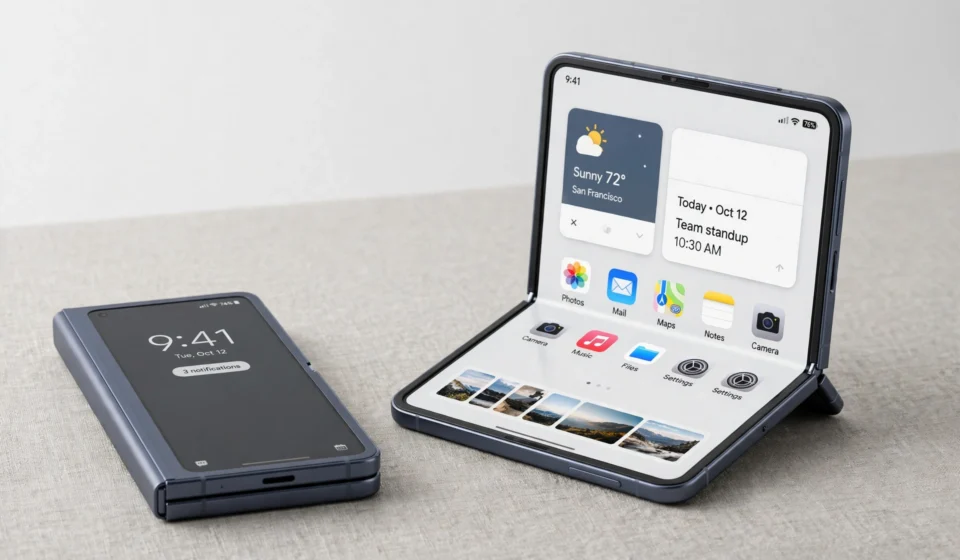

For years, a foldable phone felt like a gadget you admired and then walked away from. The idea was brilliant — a phone that opens into a tablet — but reality brought a crease, a fragile screen and a painful price. The good news is that foldable phones in 2026 are thinner, lighter and tougher than the first generations, and the question now is whether one is worth your money.
It depends on how you use your phone. If you read, watch video or work on the go, a foldable can feel like a real upgrade, not a novelty. If you mostly text, scroll and take the occasional photo, a regular flagship does the same job for hundreds less. This guide to foldable phones in 2026 covers the lineup, prices, durability and trade-offs, so you can decide.
Foldable Phones in 2026: What Has Actually Changed
The biggest change is the removal of old excuses. Samsung’s Galaxy Z Fold 7 is the thinnest, lightest Z Fold yet, opening to an 8.0-inch inner screen that is genuinely useful for reading and split-screen work, with a 200MP main camera that finally matches a top-tier slab phone. Its 4,400mAh battery is smaller than many flagships’, but it lasts a normal day.
Google’s Pixel 10 Pro Fold takes a different approach. It also opens to an 8.0-inch inner screen, runs on Google’s Tensor G5 chip, and is the first foldable with full IP68 dust and water resistance, the same rating as a normal flagship. Dust was the quiet enemy of folding phones, and a proper IP68 rating removes a big reason people stayed away.
Then the flip side. The Galaxy Z Flip 7, at around $1,099, folds a 6.9-inch inner screen into a pocket-sized square, with a 4.1-inch cover screen for messages and directions without opening the phone. Motorola’s Razr (2025), at around $699, is the cheapest way in, while the Razr Ultra (2025) at around $1,299 adds flagship power and better cameras.
The 2026 Lineup and What Each One Costs
Prices have not collapsed — they have spread out. At the top sits Samsung’s Galaxy Z TriFold, priced at $3,000 and above, with a screen of around 10 inches open. It is an engineering showcase more than a sensible purchase.
The Galaxy Z Fold 7 price sits at around $1,999 at launch — a lot for a phone, but it no longer asks you to accept a worse camera or a brick-like body for the folding screen. The Pixel 10 Pro Fold, at around $1,799, undercuts it, with that IP68 rating and Google’s clean software and long update support. Motorola is pushing from below: the Razr Fold is expected at around $1,500 to $1,699 with a battery of roughly 6,000mAh.
The market now has a real ladder. Around $699 gets you a fun compact flip. Around $1,099 to $1,299 gets you a polished flip with flagship features. Around $1,799 to $1,999 gets you a book-style foldable that replaces a tablet. And $3,000-plus gets you the TriFold, for early adopters who want a 10-inch screen in their pocket. Which is the best foldable phone 2026 has to offer? It depends on which rung matches your budget — there is no single winner.
Durability, the Crease and the Hinge
Durability is where foldables have made the most progress and where buyers should still pay attention. Modern hinges are rated for hundreds of thousands of folds — years of normal use. The screens use ultra-thin glass with a protective plastic layer, and the inner display still needs more care: no hard fingernails, no grit in your pocket, and a screen protector replaced by the manufacturer, not peeled off at home.
The crease is still there. You can see it at an angle and feel it when you swipe across the middle of the inner screen. What has changed is how much it matters: on the newest models the crease is shallower, and after a few days most people stop noticing it. If you will fixate on it, that is worth knowing before you spend $1,999.
Water and dust resistance has improved. The Pixel 10 Pro Fold’s IP68 rating is the headline, and Samsung’s recent foldables have strong water resistance too, though dust protection remains the weaker point. A case is a good idea, but it must be designed for the hinge — a regular case will not fit, and a bad one can strain the mechanism. Our earlier look at how folding displays evolved explains why today’s screens are so much tougher: https://thinkforges.com/how-foldable-phone-screens-changed-what-a-phone-can-do/
Who Should Buy Foldable Phones in 2026
A foldable makes sense if the big screen would change how you use your phone daily. Commuters who read or watch video on the train, people who juggle email and documents on the move, and anyone who has wished their phone were a small tablet will get real value from it. Flip-style phones suit a different buyer: someone who wants a full-size phone that folds to half its size and likes the cover screen for quick checks. Most popular apps are now optimised for the big inner screen, though niche apps can still stretch awkwardly.
Trade-in deals change the maths. Carriers and manufacturers regularly offer several hundred dollars for a recent flagship traded in against a foldable, bringing the real cost closer to a premium phone. Always check your current phone’s trade-in value first: a strong offer can turn a borderline purchase into an easy yes. For a wider view, our roundup of the year’s biggest innovations puts foldables in context: https://thinkforges.com/future-tech-trends-2026-7-powerful-innovation/
Who Should Skip Foldable Phones in 2026
Not everyone should buy one, for practical reasons. If you keep your phone for four or five years, a foldable’s hinge and inner screen are more moving parts to worry about, and out-of-warranty screen repairs often cost several hundred dollars. A regular flagship is a safer long-term bet.
If your budget is tight, the maths is unforgiving. A $699 Razr is the cheapest entry point, but a regular phone at the same price usually has a better camera, a bigger battery and longer software support. If you mostly use your phone for calls, messages and scrolling, you will not feel the benefit often enough to justify the premium.
So, are foldable phones worth it? For the right buyer, foldable phones in 2026 deliver — the technology has finally caught up with the idea, and the best models no longer demand big compromises. For everyone else, the honest answer is to wait: prices are falling, durability is improving, and the phone you already own is probably doing its job just fine.
The Bottom Line: Foldable Phones in 2026
Foldables in 2026 are no longer a gamble. They are thinner, tougher and more capable than ever, with choices from $699 to over $3,000. Buy one if the big screen or the compact fold will genuinely change your daily use, and pick the model that matches your budget. If it will not change how you use your phone, save your money and revisit it next year. The right foldable is the one that fits your hands, your habits and your budget — not the priciest. Check the warranty and repair costs before you pay.