
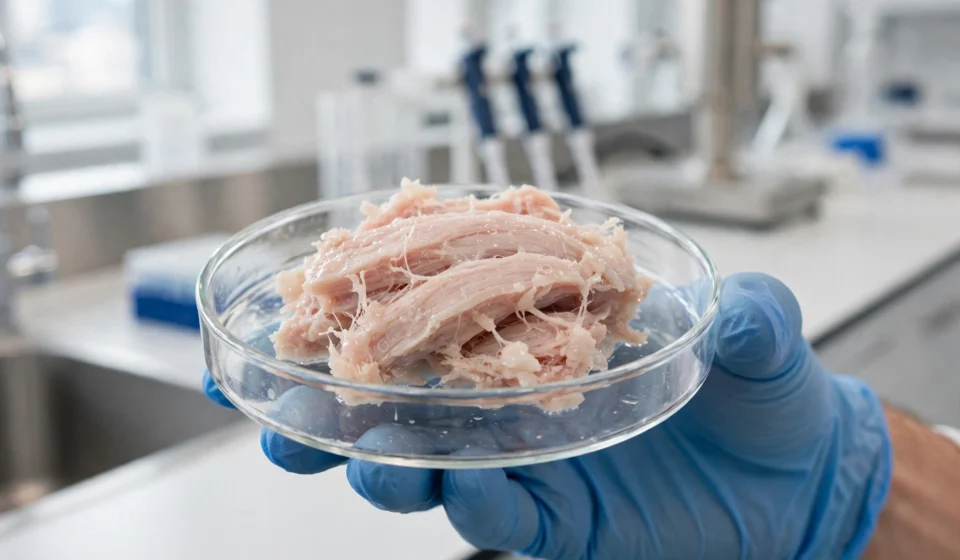

Lab grown meat sounds like something from a science fiction film, but it is already real, and it is already being served in a small number of restaurants. It is real meat, grown from animal cells in a laboratory instead of on a farm. No animal is raised for it, and no animal is slaughtered for it. The question now is not whether it works. It is whether it can become cheap enough, and accepted enough, to reach an ordinary dinner plate.
What Lab Grown Meat Actually Is
Lab grown meat is also called cultured meat or cultivated meat. All three names describe the same thing. A small sample of muscle cells, usually taken with a painless biopsy from a cow, chicken or pig, is placed in a bioreactor. A bioreactor is a steel tank that keeps the cells at body temperature and bathes them in a nutrient-rich growth medium. Over several weeks, the cells multiply millions of times. They are then encouraged to form muscle fibres, much like the fibres in a steak or a chicken breast. The finished product is harvested, shaped and cooked like ordinary meat. Early versions were closer to minced meat than to a steak, because growing a structured cut with fat, bone and connective tissue is far harder than growing a pile of cells. That is still the main technical challenge. It is worth being clear about what this meat is not. It is not plant-based meat. Plant-based burgers are made from peas, soy or wheat and flavoured to taste like meat. Cultured meat is animal meat, just produced in a different place.
How Lab Grown Meat Is Made
The process has four main stages, and each one is still being improved. First, scientists take the cell sample. A few cells are enough, because they can keep dividing. Some companies use stem cells, which can turn into muscle or fat, while others use muscle cells directly. The choice affects the texture of the final product. Second, the cells grow. They sit in the bioreactor in a liquid called growth medium. Early growth medium used foetal bovine serum, a substance taken from unborn calves, which defeated the purpose of avoiding animals. Most producers have now replaced it with plant-based or lab-made alternatives, though this was one of the hardest problems to solve. Third, the cells are shaped. For minced products such as nuggets or sausages, the cells are simply collected and mixed. For a structured cut, they are grown on a scaffold, a thin edible framework that gives them something to cling to while they form fibres. Fourth, the product is finished. The harvested meat is seasoned, formed and cooked just like conventional meat. At this stage, it is almost impossible to tell the two apart in a blind tasting of minced products, which is why the first dishes to reach the public have been nuggets and dumplings rather than steaks.
Is Lab Grown Meat Safe?
Is lab grown meat safe to eat? That is the question most people ask first, and it is the question regulators have spent the most time on. In the United States, regulators cleared the first products for sale in 2023. Singapore was first, approving it back in 2020. The safety case is straightforward. The cells come from healthy animals, the production happens in a sterile facility, and the final product is tested for contamination in the same way as any other food. Because no animal is slaughtered, there is no risk of contamination from intestines during processing, which is one of the main sources of food poisoning in conventional meat. That said, the technology is still young. Long-term studies covering decades of eating cultured meat do not exist yet, because the product has only existed for a few years. Regulators have approved it on the basis of the evidence available, and they continue to monitor production. For most people, the safety question is really a trust question: do you trust a laboratory to make your food as much as you trust a farm?
The Lab Grown Meat Price Problem
The lab grown meat price is the biggest obstacle between the laboratory and the supermarket. The first lab-grown burger, made in 2013, cost around 250,000 euros to produce. By 2023, the price of a cultured chicken nugget had fallen to a few dollars, but that was still far more expensive than a conventional nugget. The cost comes from three places. The growth medium is expensive to make. The bioreactors are expensive to run, because the cells need constant warmth, oxygen and stirring. And production is still small, so there are no economies of scale. Producers believe the price will fall as production scales up, just as it did for solar panels and smartphones. Bigger bioreactors, cheaper growth medium and better cell lines could bring the price close to conventional meat within a few years for minced products. Steaks and other structured cuts will take longer, because they are harder to grow. For now, expect to see cultured meat first in restaurants and in premium products, not in the budget aisle.
When Will It Reach Your Plate?
In Singapore, cultured chicken is already on menus. In the United States, approval was followed by a small number of restaurant launches, although some states have since restricted sales. In Europe, the approval process is still under way, and no product is on sale yet. Public acceptance will matter as much as price. Surveys show that many people are curious but cautious. Some worry about the taste, some about the idea of eating something grown in a tank, and some about whether it is truly better for the environment. Tasting events have helped: most people who try it say it tastes like ordinary meat, because it is ordinary meat.
What It Could Mean for the Planet
If cultured meat succeeds, the benefits could be large. Producing meat without raising animals would need far less land and water, and it would produce far fewer greenhouse gas emissions, especially for beef. It would also remove the animal welfare concerns that trouble many consumers. There are limits, though. Growing cells still needs energy, and if that energy comes from fossil fuels, some of the climate benefit disappears. Like self-healing materials, which could cut waste by making products last longer, this is a technology whose real impact depends on how it is made at scale. Cleaner energy would help too: if fusion energy ever reaches the grid, the factories that grow our food could run on it.
The Bottom Line
Lab grown meat is no longer an experiment. It is a working technology with its first products approved and its first customers served. The remaining questions are practical: can the price fall fast enough, will regulators approve it in more countries, and will shoppers accept it? If the answers are yes, the change could be as big as any in the history of food. The meat on your plate in ten years might come from a bioreactor rather than a farm, and you might never notice the difference.