
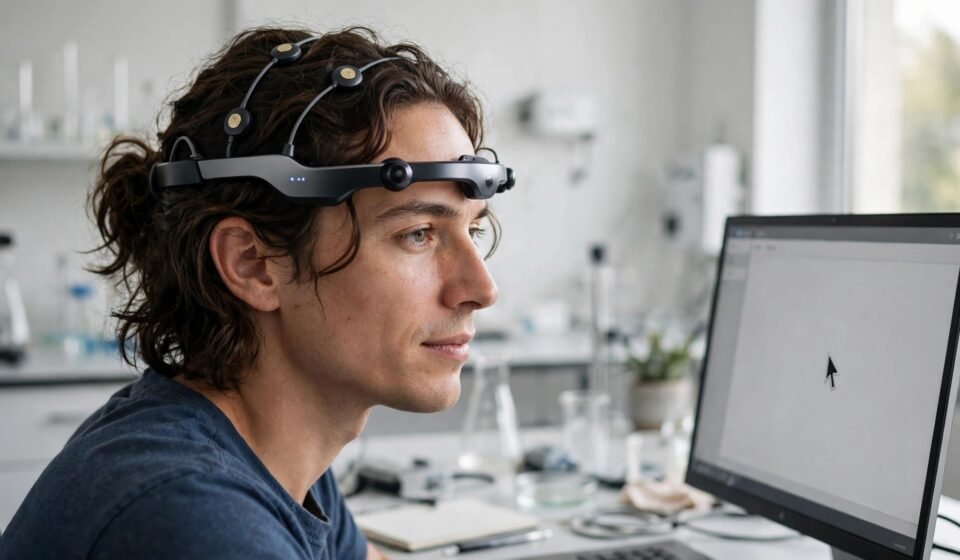

Imagine moving a cursor across a screen without touching a mouse, or typing a message without pressing a single key, because you cannot move your arms at all. That is the promise of the brain-computer interface, a device that reads signals from the brain and turns them into commands a computer can follow. The idea sounds like science fiction, but working versions are already in use. This is a brain computer interface explained in plain language: what it is, how it works, what it can do now, and what comes next.
What Is a Brain-Computer Interface?
A brain-computer interface, often shortened to BCI, is a system that creates a direct path between the brain and an external device. It skips the usual route, the brain sending signals to muscles, and reads brain activity itself. Sensors pick up the electrical patterns produced when you think about moving, speaking, or focusing, and software turns those patterns into actions: moving a cursor, selecting a letter, or steering a wheelchair.
There are two main kinds of BCI devices in 2026. Non-invasive devices sit outside the head, usually as a cap or headset of sensors that read brain waves through the scalp. They are safe, easy to put on, and widely used in research and medical testing. Invasive devices use tiny electrodes placed on or inside the brain, which needs surgery but gives a much clearer signal. The most advanced results so far, such as a paralysed person typing at close to normal speed, come from implants. Both approaches are improving fast, and the gap between them is narrowing.
Brain Computer Interface Explained: The Four Steps
The process follows the same four steps in almost every system. First, the sensors record brain activity. The brain is always producing electrical signals, and different thoughts produce different patterns: thinking about moving your right hand produces one that is measurably different from thinking about moving your left hand. Second, the system cleans up that signal, removing the noise from muscle movement, blinking, and nearby equipment. Third, software trained by machine learning matches the cleaned signal to an intended action. This takes practice: the user thinks about an action repeatedly while the system learns their version of that thought. Fourth, the device acts, moving the cursor, typing the letter, or switching on the light.
The training step is why early BCIs feel slow. A new user might take weeks to reach a useful typing speed, because the system has to learn their brain and the user has to learn how to produce clear, repeatable signals. It is closer to learning an instrument than to plugging in a keyboard, but once the system is trained it can feel surprisingly natural.
What Brain-Computer Interface Medical Uses Look Like Today
The most important work in this field is medical, and it is already real. People with locked-in syndrome, fully conscious but unable to move or speak, can now use a BCI to communicate, spelling out words letter by letter. That is a brain computer interface explained through its medical uses: the same four steps, where they matter most. People with spinal cord injuries have used implanted systems to control robotic arms, picking up a cup or feeding themselves again. Stroke patients use BCIs in rehabilitation, where thinking about moving a weak hand while a device helps it move appears to strengthen the brain pathways involved in recovery.
Researchers are also testing BCIs that detect a seizure before it happens in people with severe epilepsy, and systems that restore a sense of touch to a prosthetic hand by sending signals back into the brain. None of these are routine treatments yet, and most are still in clinical trials, but the results are strong enough that hospitals are taking them seriously. For people who have lost the ability to move or speak, a working BCI is not a gadget: it is a way back into the world.
Beyond Medicine: Where Else BCIs Are Showing Up
Outside hospitals, neural interface technology is finding smaller but growing uses. Game developers are testing headsets that let players control simple actions with focus, and virtual reality companies see BCIs as the next step after hand controllers. Researchers use non-invasive headsets to study attention, sleep, and mental workload. This is a brain computer interface explained for everyday use: the same four steps as the medical version, with simpler sensors and lower stakes. Early consumer products claim to help with meditation or focus by showing brain activity live, though the evidence is thinner.
The most talked about consumer idea is typing or controlling a phone by thought. That is still a long way from a product ordinary people would buy, because non-invasive headsets are not yet accurate enough for fast typing, and implanted devices are far too serious a step for a convenience feature. The medical uses will come first, because there the benefit justifies the risk and the cost.
The Risks and the Questions Nobody Should Skip
A device that reads your brain raises questions that no other technology does. The first is privacy. Brain data is more personal than a search history or a location record, and the rules about who owns it and how it must be protected are still being written. The second is safety. Implanted electrodes carry surgical risks, and a device in the brain needs to keep working safely for years, not weeks. The third is fairness. Early BCIs are expensive, and if only wealthy patients can afford them, the technology could widen the gap between those who can get help and those who cannot.
There is also a longer-term question about consent: if a device can read intentions, or write signals back into the brain, where is the line between treatment and enhancement? Doctors, engineers, lawmakers, and the public will need to answer that together.
What Comes Next
The next few years will likely bring three changes. First, implanted systems will get smaller, safer, and longer lasting, with wireless versions and no cables. Second, the software will get better at reading brain signals with less training, so new users reach useful speeds in days. Third, medical uses will widen, from restoring speech to treating depression and chronic pain. By 2030, a brain computer interface explained in a hospital leaflet may read as routinely as a pacemaker. If those steps land, the BCI will move from experiment to a normal part of medicine.
The Bottom Line
A brain-computer interface is no longer a fantasy from a film. It already helps people who cannot move or speak to communicate, eat, and take part in life again. Consumer versions that let anyone control a phone by thought are still years away, and the questions about privacy, safety, and fairness are still open. That, in one line, is a brain computer interface explained: thought in, action out, with software doing the translation. The direction is clear, and the people who need it most are already benefiting. For background, our beginner’s guide to artificial intelligence explains the machine learning behind these systems. And for how the home is changing, see what homes could look like in 2035.