

By 2050, around two out of every three people on Earth will live in a city. That simple fact creates a problem that is easy to state and hard to solve: how do you feed millions of people who live far from the fields where food grows? Trucks already carry vegetables hundreds of miles to city supermarkets, and much of that food spoils on the journey. Growing food upwards is one answer to that problem, and it is moving from a curious experiment to a serious part of how cities feed themselves.
If you have ever wondered about vertical farming how it works, this guide answers it in plain language, and explains what it could mean for the food on your plate.
Vertical Farming How It Works, Step by Step
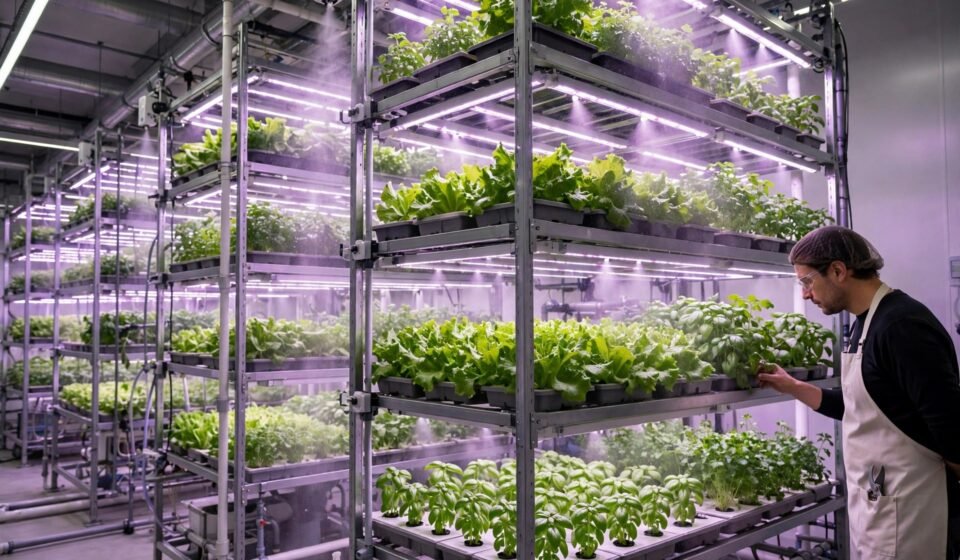
Vertical farming means growing crops in stacked layers inside a controlled indoor space, instead of spreading them across open fields. The farm is usually a warehouse, a container, or a purpose-built building. Inside, plants sit on shelves several metres high, each holding its own tray of leafy greens, herbs, or strawberries. LED lights stand in for the sun, tuned to the exact colours each crop needs at each stage of growth. The temperature, humidity, and airflow are set by computer and held steady day and night, so the plants never face a heatwave, a frost, or a storm.
Water is where the system really differs from a field. Most indoor farming systems do not use soil at all. In a hydroponic setup, plant roots sit in a stream of water carrying dissolved nutrients, which is collected, filtered, and used again. In an aeroponic setup, the roots hang in the air and are misted with nutrient water every few minutes. Either way, the farm recycles almost all of its water, which is why vertical farms claim to use up to 95 percent less water than a field growing the same crop. The plants also grow faster, because they get light, water, and nutrients on a perfect schedule.
The debate about hydroponics vs vertical farming often confuses people. Hydroponics is a method of growing plants without soil. Vertical farming is a way of arranging a farm, stacking crops in layers indoors. A vertical farm almost always uses hydroponics or aeroponics, but a hydroponic farm does not have to be vertical. In short, vertical farming how it works comes down to three things: stacked layers, tuned light, and water used again and again.
What Grows Well in a Vertical Farm
The best crops for indoor farms are the ones that are light, fast-growing, and valuable by weight. Leafy greens lead the list: lettuce, spinach, kale, and basil thrive under LED lights and can be harvested in a few weeks. Herbs such as mint, coriander, and parsley are popular too, because restaurants pay well for them. Strawberries are the most exciting newcomer, since they sell at a high price and can be grown year-round.
What does not work yet is almost everything else: wheat, rice, corn, and potatoes need far too much space and energy per calorie to make sense indoors. A vertical farm cannot feed a city on its own, and anyone who claims otherwise is overselling the idea. Its real job is to supply the fresh, perishable foods cities struggle to get in good condition: salads, herbs, and soft fruit. Staple calories will still come from fields for a long time to come.
Why Cities Are Paying Attention
Urban agriculture is not a new idea: people have grown food in cities for centuries, on rooftops, in back gardens, and on small plots. What is new is the scale and the reliability. A vertical farm can sit in the middle of a city, a short drive from the supermarkets and restaurants it supplies. That short journey matters. Leafy greens lose nutrients and freshness from the moment they are picked, so a leaf that travels for three days is a very different product from one picked this morning nearby. Growing close to the customer also cuts the fuel, refrigeration, and packaging that long supply chains need.
That short, simple chain is vertical farming how it works at its best: fresh food, grown nearby, delivered fast.
There is a second advantage that matters just as much. Because the growing environment is fully controlled, a vertical farm produces the same quality crop in January as in July. There is no bad season, no drought, and no pest outbreak, because pests rarely get inside a sealed building. That reliability attracts supermarkets and restaurant chains, which need a steady supply they can plan around.
The Cost Problem Nobody Can Ignore
If it is so good, why is it not everywhere already? The answer is cost, and it is a serious one. Building a vertical farm is expensive: the shelves, lights, pumps, sensors, and climate control all cost money before a single leaf is sold. Running it is expensive too, because LED lights and air conditioning use a lot of electricity. In places where electricity is cheap and clean, the maths can work. In places where it is not, it often does not. That energy bill is the part of vertical farming how it works that most often decides whether a farm survives.
That is why many early companies in this field struggled or closed. Some grew too many crops, expanded too fast, or promised investors returns the farms could not deliver. The survivors are the ones that picked the right crops, the right locations, and the right customers: high-value greens sold fresh to nearby buyers. The industry is learning the same lesson every new technology learns: being clever is not enough, it also has to pay.
What Comes Next for Indoor Farming
LED lights keep getting cheaper and more efficient, which cuts the biggest running cost. Sensors and software are getting better at spotting plant stress early, so farms waste less. Some farms now use robots to move trays, plant seeds, and harvest, which cuts labour costs and keeps the growing area cleaner. Others pair their farms with solar panels or waste heat from nearby buildings, so the energy bill drops.
Cities are also starting to treat vertical farms as infrastructure. Singapore, which imports almost all of its food, aims to produce 30 percent of it locally by 2030, and vertical farms are a big part of that plan. Other cities are watching closely: if the model works in Singapore, it can work anywhere. That kind of public backing shows how far vertical farming how it works has come, from experiment to infrastructure.
The Bottom Line
Indoor farming will not replace fields, and it should not try. Its job is narrower and more useful: to grow fresh, perishable food close to the people who eat it, using far less water and land than the old way. Put simply, vertical farming how it works is stacking, light, and recycled water, repeated on every shelf. The technology is real, the economics are improving, and the cities that need it most are already building it. The next time you buy a bag of salad that was picked this morning a few miles from the shop, there is a good chance it grew upwards, not outwards.
For a wider look at how farming is changing, see our roundup of agriculture innovation trends. And if you are curious about another way technology is changing food, lab-grown meat is worth a read too.