
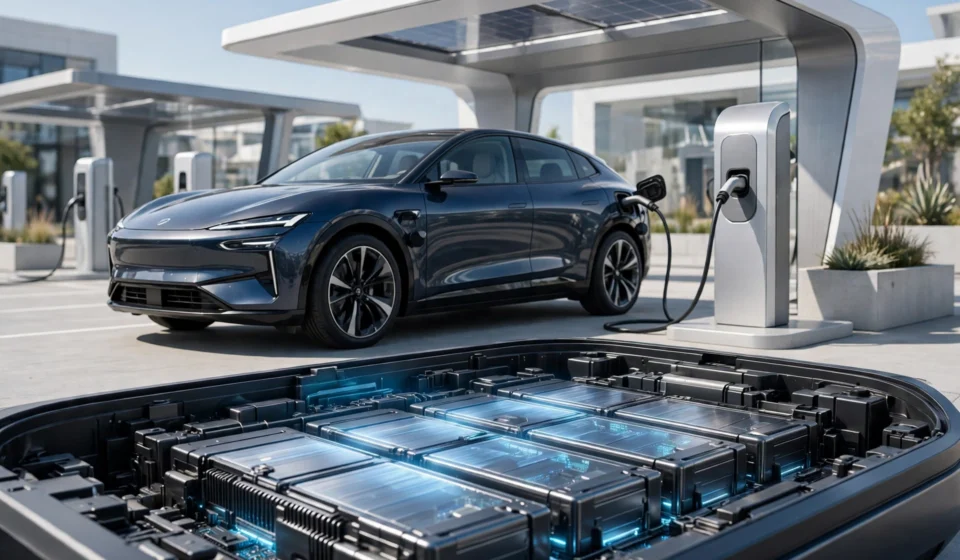

Every electric car on the road today runs on the same basic technology: a lithium-ion battery filled with a liquid. That liquid works, but it is also why electric cars take so long to charge, lose range in cold weather, and carry a small but real fire risk. For years, engineers have talked about a replacement that could fix all three problems at once.
Solid-state batteries swap the liquid for a solid material, and if they work at scale, they could be the biggest change in electric cars since the first modern EV arrived. Here is what they are, how they work, and when you might buy a car that uses them.
What Makes Solid-State Batteries Different
A battery is two electrodes with something between them that moves charged particles back and forth. In today’s lithium-ion batteries, that middle layer is a liquid electrolyte. It does the job, but it is flammable, it limits how much energy you can pack in, and it degrades over time.
Solid-state batteries replace the liquid with a solid electrolyte, usually a ceramic or a special polymer. The solid layer does the same job of moving ions, but it does not catch fire, it handles higher voltages, and it allows a pure lithium metal anode, which stores far more energy than today’s graphite anode.
The result, in theory, is a battery that holds more energy in the same space, charges faster, lasts longer, and is much safer. That is why almost every major carmaker and battery company is working on it.
Why Electric Cars Need Them
Today’s electric cars are good, but they still ask drivers to make compromises. The most obvious is range: a petrol car can be refuelled in five minutes and drive for hundreds of miles, while an electric car needs a long stop at a fast charger and loses range in winter.
The second is charging time: even the fastest chargers take twenty to thirty minutes to add a useful amount of range. The third is cost, since batteries are the most expensive part of an electric car and keep prices higher than most buyers would like.
Solid-state batteries promise to improve all three. More energy in the same space means longer range. Faster charging means a stop closer to a petrol station visit. And a simpler, safer design could eventually mean cheaper batteries, once factories learn to make them at scale.
How Much Extra Range Are We Talking About?
Nobody knows for sure, because no mass-market car uses the technology. Laboratory results suggest energy density could be roughly double today’s best lithium-ion cells. In a real car, that might mean 600 to 800 miles on a charge, compared with 250 to 350 miles for a typical electric car today.
Even a 500-mile range would change how people use electric cars: long road trips would stop needing careful charging plans, and drivers who cannot charge at home would need to visit a charger far less often.
The EV battery range question is the one that keeps many buyers on the fence, and solid-state technology is the clearest answer the industry has. Carmakers may not use all of that extra density for range, though: some may build smaller, lighter batteries instead, which would make cars cheaper and more efficient. Either way, the driver wins.
Charging: The Other Big Promise
Solid-state battery charging is the second headline promise, and it may matter more than range. Because the solid electrolyte is more stable, these batteries can accept very high charging currents without the same risk of damage. Some prototypes have charged from 10 to 80 percent in under ten minutes, and a few laboratory cells have done it even faster.
There is a catch: charging that fast needs chargers that can deliver enormous amounts of power, and most of today’s network cannot. The car and the charger have to improve together, but if the battery can take the power, the infrastructure will follow.
What Is Still Standing in the Way
If solid-state batteries are so good, why can you not buy one yet? The answer is manufacturing. Making a solid electrolyte that works in a laboratory is one thing; making millions of them, cheaply, reliably, and without defects, is much harder.
The solid layers are brittle and can crack, and the connection between the solid electrolyte and the electrodes can degrade over repeated charging. Several companies have pushed back their timelines more than once, and a few promising early prototypes proved too fragile for real cars. Most realistic estimates now put the first limited-production cars in the late 2020s, with wider availability in the early 2030s.
Who Is Closest to Getting There
Almost every major carmaker has a solid-state programme, but they are taking different routes. Toyota has been the most public, talking about cars on the road before the end of the decade. Samsung’s battery division has shown prototype cells with very high energy density.
Chinese battery giants CATL and BYD are working on their own versions, and some Chinese carmakers have already shown cars with semi-solid-state batteries, a halfway step mixing solid and liquid electrolytes.
The race is open, and the winner may be the company that can build a factory turning out reliable cells by the million, not the one with the best laboratory result.
What It Means for Phones and Laptops Too
Cars get most of the attention, but the same technology could change smaller devices first. A solid-state battery in a phone could mean a thinner device with two days of battery life, and a laptop that charges in minutes. Small batteries are easier to manufacture than the huge packs a car needs, so the technology may arrive in gadgets before it arrives in cars.
Our earlier look at what solid-state batteries could mean for phones and laptops explains that side of the story. The car industry is the bigger prize, but the phone in your pocket may be where you first meet the technology, in premium products first, before the price falls enough for everyone.
Should You Wait for a Solid-State Car?
If you are thinking about buying an electric car today, the honest answer is probably not. Today’s lithium-ion cars are already good, they keep getting better, and the charging network is growing every year. Waiting five or more years for a technology that may arrive late means five years of petrol costs and missed savings.
The people who should pay closest attention are second-time electric car buyers, or those who regularly drive very long distances in cold weather, where the extra range would matter most. For everyone else, the current generation is a sensible buy. But keep an eye on the news: when the first solid-state battery electric cars arrive, they will change what buyers expect entirely, and the whole market will have to respond.
The broader shift in how we travel is already under way, as our guide to the future of transport innovations changing how we travel in 2026 shows. Solid-state batteries are the next chapter of that story, and it is a chapter worth waiting for, just not worth waiting in a petrol car for.